Tuesday, 6 April 2010

At Bertram's Hotel (1965)

Plot: Can Miss Marple go on holiday without packing murder? Well, no.


At Bertram's Hotel is an unlikely companion piece to Passenger To Frankfurt. You expect certain things from a Miss Marple - murder, gossip and tea - and this book has all of those. But it's also UTTERLY BATTY.

You think it's going to be a sedate crime story and then you realise this is Christie pulling off one of her bizarre thriller capers. There are vast criminal conspiracies, counterfeit clergymen, money-laundering syndicates and even an entire hotel that isn't what it seems to be.

The central conceit of At Bertram's Hotel is that it is too good to be true - rather like a set from a bygone era ("Nne of this place seemed real at all"). This doesn't quite come across in either TV adaptation - after all how do you make a period drama look even more stylised?

It dominates the book as a character, represented through various mouthpieces, such as the glacially perfect receptionist and the far too brilliant maitre'd. The joy though is realising that almost the entire staff of the hotel and a good many of the guests are actors hired to play the part - an idea so wonderfully batty it turns up in a couple of episodes of The Avengers (one of them made before this was published).

Talking of The Avengers, say hello to Bess Sedgwick "she had been a member of the French Resistance... had once saved two children from a bruning house... was said to be the second-best dressed woman in Europe... she had successfuly smuggled herself aboard a nuclear submarine". If the book doesn't exactly feel authentically 60s, the rip-roading Bess is really something new, like the Plucky Young Gals of 20s Christie, but somehow brighter and colder - there's a lovely moment when Miss Marple and her friend look carefully at Bess, wonder if she's happy and decide "no."

Miss Marple observes all of this from an easy chair "Everyone's universal great-aunt" - and she's a perfect central character for this book, sitting there like the events are a play staged just for her. She doesn't miss a thing.

There's a lovely scene where she goes for a walk through a changed London. "She visited no picture galleries and no museums... What she did visit were the glass and china departments of the large stores" and remarks on everything that has changed. "There must be progress I suppose" she laments, quietly. Later on she comments "Life is really a One Way Street, isn't it?" - which is both the solution to the crime and also slight hint that Miss Marple's not so out-of-touch (I've wikipedia'd the phrase and it seems to have been invented in 1909, but I'm wagering only really caught on in England during the great 60s expansion in town planning).

This is then followed by a coincidence (remarkable in real life but fitting in this book) of having two characters play out a scene just when Miss Marple sits down to tea, and Christie has great fun in playing up Miss Marple's desperate attempts to eavesdrop.

The book has a remarkable heroine in the figure of Bridget, a sort of orhpan who plods through the book tracking down her parents. While not as straight down-the- line as other heroines such as Lady Bundle Brent, she's plucky, inventive and daring. She's the hare to Miss Marple's tortoise.

What is curious about having a parentless child is that the book's detective is nicknamed "Father" throughout, resulting in a remarkable scene where he stands in loco parentis for Bridget.

From a gender point, this is a very curious book. All the women in it are independent, strong willed and display various degrees of cunning, and are pretty skilled at deception (whether it's mere politeness or grand larceny).

With the exception of Father, the men are quite lacking. They're mostly well-meaning, but often baffled, or not seeing the full picture. Even the book's male villans are limp. This includes the obvious gigolo racing-car driver Ladislaus, who is oddly intangible despite clearly shagging a mother and her daughter. Which would be shocking if he were more of a character.

Father is a triumph - a roly-poly avuncular menace he's like Sgt Battle in some ways. He pretends to be the junior policeman, he potters around in plain clothes, he plays the fool ever-so-slightly, but he takes Miss Marple seriously in a quite remarkable moment when he says: "I'm not going to arrest you Miss Marple. You have an alibi". The old lady is quite put out - and this is the first policeman to get one over on the love.

There are a few interesting traces of modernity. The delightful Canon Pennyfather may have wandered in from Anthony Trollope, but he goes for a curry. Sexual liberation is everywhere - when Bridget proclaims her romantic adventures in an Italian Convent her mother sighs "Every girl your age has a Guido in her life." There's the villainous Ladislaus with his sexual appetites, and there's even mention of a dodgy doctor who got struck off "helping a lot of girls who were no better than they should be".

Another sign of this being late Christie is the freewheeling plot. At the same time as reading this I was trying a Ngaio Marsh. She's very good - but nearly all her books follow the classic "Crime / Interrogation of all the Suspects / Revelation" structure, which is somtimes incredibly tiresome (and may explain why I don't care for Five Little Pigs although everyone else loves it). At Bertram's Hotel has no such structural limitations - it's all over the shop, but in a way that's constantly engrossing and surprising. True, the denoument is a mixture of masterclass and magic, but it's never ever dull. Which is quite a surprise when you consider that there isn't a murder until two-thirds in.


"I am not really fond of interfering. Though well meant it can cause a great deal of harm."


There's a real sadness at the heart of the book. Frequently when Miss Marple brings someone to justice we feel only pleasure. But this time she's pitted herself against a building, and she feels real regret at having to bring it down. "She felt sad - for Bertram's Hotel and for herself."

Wednesday, 10 March 2010

Passenger To Frankfurt (1970)

Plot: Hitler's Lost Son and some Hippies take over the world!


“Where do you get your ideas from?” Agatha Christie ponders in the introduction. This bold, mad romp is isn't so much inspired as improvised, changing tack, plot and characters from page to page.

This would matter more if it wasn't so bloody entertaining from moment to moment. It's only as you approach the end that you think “No, now, hang on a minute, this isn't fair...”

We start with Sir Stafford Nye – a diplomat who, we are assured, would go far except for his addiction to jokes. This is surprising as he tells Not One Joke throughout the entire book. He's a game old bird and enters into an intrigue with the mysterious Passenger To Frankfurt, becoming involved in an international conspiracy which is thrillingly described and then.... peters out oddly.

We switch several times to the rooms of some high-powered diplomats, some of them vividly described in clouds of cigar smoke, some of them utterly faceless (one of them's a villain, by the way, but when they're unmasked you'll have a great moment of “uh, who is that again?”).

We then switch away to Stafford's marvellous octogenarian Aunt Matilda. She's a wily old bird and has realised that there's a conspiracy afoot To Destroy Civilisation. So she promptly goes on holiday to Bavaria, where she encounters the conspirators, among them a very fat lady, Hitler's Son, and what appears to be the SS who are taking over the young of the world by organising some nice concerts with decent catering. Crikey.

Poor Sir Stafford wanders back in and then potters out like he's forgotten his keys. At one moment he laments that “Fiction was infinitely superior to real life”, which all depends on your point of view. He's frequently either clutching an enigmatic stuffed panda or a glamorous young woman/princess. Who he may or may not be in love with, who may or may not be related to him, who may or may not be about to destroy the world. Occasionally he plays Wagner on the recorder and who can blame him?

That this all makes sense as you're reading it (but not immediately afterwards) is quite a tribute to Christie. She's an utter poppet for wonderful diversions, such as Aunt Matilda remembering that as a child she wasn't allowed to read novels in the morning, and who hints thickly (and entirely erroneously) that the mystery hinges on The Prisoner Of Zenda.

Occasionally we'll hear that Washington has been destroyed by rioting children, or that planes are being hijacked and taken to Africa. A figure somewhat like General de Gaul will take to the streets of Paris in an attempt to quell the uprising, but it's all too complicated and sometimes has a bit to do with biological warfare and sometimes to do with the destruction of all the airports across Europe. There's even a diagram of the conspiracy, which really doesn't help at all, but looks a bit like a flower. Which is pretty.

There's a remarkable scene recalled in an insane asylum featuring Hitler talking to some Hitler impersonators, which may go some way towards explaining the diabolical schemes of a large woman called Charlotte. Then again, it may not, as contradictory explanations are given – frequently and bafflingly.

It ends in a remote house in Scotland where the solution is... well, only possible to wor out if you've been paying very close attention. And even then, it's quite remarkably odd, like late Margery Allingham doing battle with GK Chesterton sieved through a worn sock. But there's a wedding, although quite why that happens isn't explained.

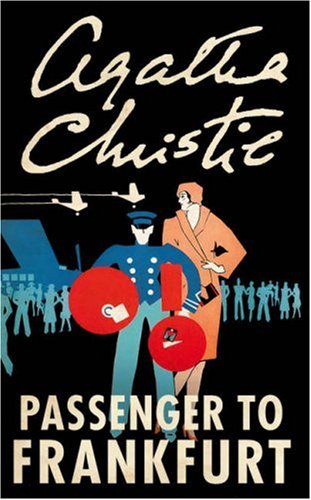
It's a lovely, maddening pudding of a book. That you'll love a bit despite yourself. Notice the interesting cover of the current edition – the book itself is like the 1920s trying to engage with a world of punk and flower power. But the book cover tuts and goes for some nice frocks. And bless it for that.

We also never find out the significance of the stuffed panda.

NEXT: Why didn't they ask Evans?

Tuesday, 2 March 2010

Three Act Tragedy (1934)

Plot: A famous actor enlists Poirot and Satterthwaite's help to investigate a series of baffling murders.


Poirot may never have teamed up with Miss Marple (Christie claimed they'd annoy each other – which is THE WHOLE POINT), but he cheerfully twins the Belgian Brain with the Love Detective to solve what looks like a drawing room crime mystery.

Called in by famous thesp Sir Charles, the crimes suit both detectives – for Satterthwaite there is a love to bring about, and for Poirot there is a cunning crime. And Sir Charles himself isn't beyond playing the detective.

The whole book is staged – Christie admits so by providing a cast list and credits at the beginning (and even a hint of the solution). As Charles Osborne points out in his book on Christie, this is a book where the murderer, once you fix on them, is quite blindingly obvious (indeed, the recent TV adaptation has to go to Utterly Extraordinary Lengths to try and overcome this, leaving you shouting “Why aren't they showing XXX in shot? Why?”). And, it is worth mentioning, this is one time when the Butler did it. Well, kind of. But this is after all, a staged mystery.

Satterthwaite works very well with Poirot. His first observation of the man has him “suspecting him of deliberately exaggerating his foreign mannerisms”, an admission that Poirot later makes himself.

Poirot is content to background himself (“It is Sir Charles who must have the star part” he says) – except for at the remarkable curtain line (“It might have been ME.”). This doesn't prevent him from being as playful as the murderer – the scene where he stages a murder of his own is, when you read it a second time, extraordinarily inventive, and sees Poirot actually taking the murderer on at their own game.

Poirot isn't the only one making acute observations and impersonations. Christie's ear for servant dialogue shows itself again. There's Mrs Leckie who gets an entire page of dialogue with barely a pause for breath, and marvellous it all is (“good girls they are, every one of them – not that I'd say that Doris gets up when she should do in the morning,..).

Fittingly, the book includes an author in peril – a shy mousy, malicious woman who is content to observe life and knows more about what's going on that she lets admits. If it is a Christie self-portrait, it's an odd one. Literary theorists will be delighted to discover that the last chapters of the book feature a race by the detective to save the life of the author, for in reality, the poor dear is as much a victim as one of her own creations as the characters elsewhere in the book. Er, discuss.

NEXT: Hitler's secret son! Hippies destroy the world! It's Passenger To Frankfurt!

Saturday, 20 February 2010

Mysterious Mr Quin (1930)

Plot: We meet a supernatural love detective

Christie takes a sharp left here. This is clearly the same author who created Hercule Poirot, but this is also the same author behind the mystical bittersweet collection of While The Light Lasts.

Mr Quin and Mr Satterthwaite are a fascinating duo. Mr Satterthwaite is a well-meaning man of means who has never really taken part in life. He lives in luxury, but is entering his retirement, and cannot see himself ever loving, so contents himself with sharply observing others. He's fashionable and snobbish and fussy - but he's also concerned about the happiness of other people, and takes a keen interest in human nature.

In many ways, he's an equivalent of Poirot - a man content to travel the world, occasionally becoming involved in adventurers, watching everything with his beady eye. But he isn't brilliant - his brain needs that extra push.

The extra push comes from Mr Harley Quin, a mystical figure who comes and goes like magic, part of the ancient Harleyquinade (a pantomime that turns up several times in Christie). Quin appears like a benevolent, sometimes avenging, spirit of love.

It is Quin who uncovers long-ago crimes, allowing suspicious lovers to realise that both are innocent. It is Quin who confronts the Croupier and fallen, fashionable ruin of his first wife, and allows them to forgive each other. Quin is a malevolent spirit - and his meetings with Satterthwaite are nothing but ordained. Unlike those Poirot cases where the reader's eyes roll up at the sheer coincidence, Mr Quin is clearly a supernatural power restoring order to the world, summoning Satterthwaite to help him.

It is the last story that the ambiguous nature of Quin is teased at with the Lovers' Lane, where Mr Satterthwaite gets a glimpse of "something at once menacing and terrifying... Joy, Sorrow, Despair."

At the end, we have Satterthwaite alone, humbled before ...what?, forced to ask himself whether his contented life without love has been worth it after all.

Saturday, 13 February 2010

While The Light Lasts (1997)

Plot: Random love stories with a bit of Poirot.


While The Light Lasts is a curious collection. It's almost a merging of the supernatural and the romantic magic of Mary Westmacott with a very, very occasional crime thrown in.

The Edge is the most curious story - if you're a fan of reading autobiography into fiction. It's about a dowdy lover cast aside by a shallow man for a young beauty. Published just after Christie found out about her husband's affair and ran away, it's easy to assume that this is a little act of revenge.

There's also a lot to love about Manx Gold. The story itself is pulp Christie, but the idea of hiding the clues to a real treasure hunt throughout the narrative is extremely innovative, even if you actually have to be standing on the Isle of Mann to stand a chance of solving any of them.

The Actress is a story about a plucky actress thwarting a blackmailer - and it's easy to see in this the prototype for all of Christie's quick-witted and frequently villainous actresses.

There's also The Lonely God, a surprisingly kind story about love winning out in the end, thanks to a sweet-natured idol.

But that's about it for upbeat. Ignoring the Poirot reprints of early versions, the rest of the collection is about the thwarting of love. Painters and paintings abound - Within A Wall features a painter who only realises the true nature of the woman he loves and the woman he hates when it is too late. The House of Dreams is about a vision and madness, and While The Light Lasts features the shock of a returning husband and a last glimpse of happiness - an idea which turns up in Taken At The Flood.

Is it a great collection? Maybe not. But it is refreshingly different after a diet of pluck, twists and endless impostors.

Sunday, 31 January 2010

The Thirteen Problems (1932)

Plot: Miss Marple solves the problems of an after dinner Mystery Club.


If Murder At The Vicarage was an establishing book it is The Thirteen Problems which makes Miss Marple's reputation. It is during these quiet tales that Miss Marple moves from being a clever village gossip to an international crime solver - without really leaving her inglenook and knitting.

For it is here that she meets Sir Henry Clithering of Scotland Yard, and a circle of friends including actresses and artists and other notables. In other words, it is here that Miss Marple makes a name for herself - and she does not waste the opportunity.

These are all stories where the solution is neatly provided by Miss Marple, often at the expense of the teller - the rule of thumb is that the Brighter the Young Thing the bigger their downfall will be at Miss Marple's hands.

Poor Raymond West is dispatched by her on page three ("do you think people are really so unpleasant as you make them out to be?" which is Miss Marple being perhaps a little hypocritical - especially when she says "I hope you dear young people will never realise how wicked the world really is").

Initially overlooked by artist Joyce, Miss Marple later "accidentally" exposes her engagement to Raymond. In sketches about the spinster, the joke is that she is actually the murderer - but this ignores Miss Marple's formidable skills at character assassination. She reserves her biggest guns for daffy actress Jane, who constantly mocks Miss Marple ("I'm sure I shouldn't have any brains at all if I lived in a village"). She may receive her comeuppance off-stage, but it is devastating nevertheless.

The stories themselves are the usual Christie short story - with inveigling servants, deceptions, disguise (there's even two uses of roughly the same plot about swimming and impersonation) and sleight of hand. Several times the dead body isn't the dead body you're lead to believe. At other times, it is the victim who is changed. That's not to be snippy about these stories - the telling of them is extremely engaging, and the stories work on three levels - as a mystery, as an occasionally devastating self-destruction by the teller, and as a revelation of Miss Marple's supreme brain.

Some of the mysteries are extremely clever and centre as much on the smart noticing of details as Miss Marple's famed tiny recollections of village life. Christie makes great use of her chemical experise - both in the poisonings here, and in one instance, in the side effect of a chemical reaction. There's even, in The Idol House of Astarte, a seeming flirtation with the supernatural - which is never completely debunked. True, the murder turns out to be quite natural - but the circumstances which occasion it remain remarkable.

The main joy is in seeing Miss Marple herself telling stories. In one of them she reveals precisely why she thrives on gossip: "How often is tittle-tattle, as you call it, true!" In the same story she even recounts her failures - the number of times she's realised a husband will try and destroy his wife and failed to prevent it. It's one of the darker insights into her psyche - she claims that husbands are tempted to this because they are stronger. The inference is that wives would do it more if they could...

This book is both charming and necessary. From here on in, Miss Marple is free to roam, an acknowledged solver of crimes. Her path to Nemesis is laid open.

Next: Supernatural frolics in the name of love in The Mysterious Mister Quinn

Monday, 18 January 2010

Poirot Investigates (1924)

Plot: More early cases! Missing jewels, ancient curses and prime ministers for Poirot.


This collection of Poirot short stories shares several familiar themes. Risking mild spoilers, I'm going to lump them as follows:


Don't trust the servants!

The Jewel Robbery At The Grand Metropolitan and The Mystery Of Hunter's Lodge and The Italian Nobleman all demonstrate this in different ways - all complicated puzzle box mysteries where the only possible solution is that the only people who could have done it are the people you're not supposed to notice. In one case, the butler actually does it.

Impostors!

Christie's fascination with disguise and identity runs through the collection. Two of the above stories are about servants who aren't servants, but we also get The Disappearance Of Mr Davenheim (a thief who isn't a thief), The Million Dollar Bond Robbery (naughty nurse and fake passenger), The Cheap Flat (substitute victims), The Western Star (impostor jewels), and the Kidnapped Prime Minister (guess who isn't quite what they appear to be here?).

Of course, this lumping is a gross simplification - each is just a facet in a constantly recut puzzle. But, if you want to solve-along-with-Poirot, it's a wise bet to keep a suspicious eye on the servants, overlapping alibis, and people who might not be who they claim to be.

If we're going to carry on in this slightly facetious mood, we'll miss the fun. The Egyptian Tomb, for instance, could be said to be about faked symptoms and false curses, but that's to ignore an atmospheric tale of foreign travel, mysterious shadows and, of course, the contemporary fun of Tutankhamun's Tomb.

The Tragedy Of Marsden Manor has a similar dance - it's pure atmosphere, even featuring a ghost. The ghoulish aspects of the story become enormously enhanced in the telly version, which looks like a prototype Jonathan Creek.

The fun-from-beyond-the-grave continues with The Missing Will, an adventure where a dead man sets his niece a puzzle - there's an interesting parallel here with Miss Marple's final cases, which are pretty much concerned with hidden wills, mysterious legacies and impossible disguises.

These stories may be slight, but there's plenty of time to fit in the odd thriller - The Cheap Flat looks like it might be about the difficulties of renting somewhere nice in London, but it's actually about an international spy ring. The Kidnapped Prime Minister pulls off the same trick of global scandal happening around Poirot, who plays the eye of the storm, even famously stating his methods - refusing to fly about Europe or look for cigarette ash, he simply pounds his head and announced "The clues are within HERE!".

And that's kind of the summary of these cases, where Poirot is the calm eye of the storm, quietly, patiently solving all manner of outlandish mysteries. Or just about managing to unmask yet another fake servant without rolling his eyes.

NEXT: Miss Marple solves The Thirteen Problems