Showing posts with label house of evil. Show all posts

Sunday, 6 February 2011

4.50 from Paddington

Plot: Unique serial killer romp about British Rail and the National Health Service

Lucy  Eyelesbarrow. There's other stuff in 4.50 from Paddington, and it's all good, but it's Lucy Eyelesbarrow who dominates this book. She is Agatha Christie's ultimate answer to The Servant Problem - what if a really clever, independent woman took up domestic service. With a First in Mathematics at Oxford, Lucy is the perfect servant - her brains, tact and beauty amply rewarded by gratetful employers. She takes on the job of hunting down a murderer because it appeals to her and because she likes Miss Marple - recognising in her both her brains and her character

Lucy is a truly marvellous example of a really independent Christie heroine - and it is a crushing shame that she's landed with a romantic plot - will she pick boring-but-brave Brian or charming-but-caddish Cedric? You very quickly start yelling "Neither! Neither!" and even Christie chickens out of sentencing Lucy to purgatory with either of them. The only possible appeal of Brian is his charming son, who Christie writes gloriously, even allowing him and chum Stoddard-West a glimpse of a dead body ("One's only young once."). Possibly, Lucy should wait until Alexander comes of age and make her move. The charming Alexander, however, is most keen on the match:


Averting his eyes to the ceiling, he said rather self-consciously:
"I think, really, you know, it would be a good thing if he married again... Somebody decent... I shouldn't, myself, mind at all having a stepmother..."

Just because Lucy is some grand doesn't mean that Miss Marple takes a back seat. In the early stages of the book she does some great detective work in finding the location of the mysterious corpse - she draws up a charming plan of action ("4. Griselda's boy Leonard who is so very knowledgeable about maps.") and then travels on a lot of trains. The reliability and state of the Nation's railways places this book firmly in the 50s, with Miss Marple remarking on the decline of First Class ("This taxation... that's what it is. No one can afford to travel first class except business men in the rush hours. I suppose because they can charge it to expenses.").

This is a remarkably post-War novel. The Crackenthropes of Rutherford Hall are once-rich industrialists whose principal remaining asset is their estate - sat in the middle of an expanding town, it is eagerly wanted by developers to bulldoze and turn into new housing. Rutherford Hall itself is seen as valueless - a mouldering stately home mostly closed off and impossible to keep up due to taxation and The Servant Problem. The house is presided over by the archetypal decayed gentleman, Mr Crackenthorpe, a man who cackles when his children are bumped off ("I'll outlive them all," he crowed, "You see if I don't.")

We also see the remarkable effect of the brand new National Health Service on poor Dr Quimper, a man driven almost mad by overwork and sleeplessness.

The book also features one of the oddest coincidences in the revelation of just who Edmund Crackenthorpe's lover in the French Resistance was. It's honestly a moment that would have you throwing the book across the room were it not being handled by Agatha Christie. Even then, it's touch and go.

One of the oddest things about this book though is the tone - it's a deeply horrible, tragic tale, but it's told in a tone of almost constantly upbeat, light-hearted whimsy, which is as charming as it is unsettling. It still doesn't stop Lucy Eyelesbarrow from stealing the show. I just hope she didn't marry either of them in the end.

Sunday, 14 November 2010

After the Funeral (1953)

Plot: Nun of it's what it seems.

Look out! There's mis-direction thundering through this book. The identity of the killer is boldly given away very early by a stray comment about the pleasing nature of a bath bun. But even so, this is just an audacious hint that what seems to be a country-house murder is Anything But.

Yet more proof that Christie changes with the times is that she's prepared to write a book with such a novel twist on The Butler Did It. You think (for quite a while) that this is all about the murder of a man with a legacy and his frankly awful family – but this is, instead, not about these people at all. To say the family are entirely red herrings is slightly unfair, but they are mostly ghastly window dressing for a very subtle crime.

When the unveiling happens, Christie's prose is at its best with the killer's description of their goals in life:
“One can occasionally get quite nice china – export rejects – not that awful white utility stuff.... Oak tables and little basket charis with striped red and white cushions.”

This is followed by the gasp “I've never imagined a lady-like murderer”. It's the “-like” that's deadly. The killer even shouts “Of course, one never looks much at...”. This isn't quite a middle-class mystery, but Christie shows that she's quite prepared to get inside the heads of people you assume she wouldn't have much time for.

In some ways the killer is a redrawing of Dora Bunner from A Murder Is Announced – someone with reduced circumstances but no poverty of ambition. And, frankly, one of the messages about this book is that good money is wasted on bad people.

Christie has visited this idea in books like A Pocketful Of Rye and Taken At The Flood – the idea of a cursed house full of vile people gradually reaching a kind of grace, but in this book almost the entire cast are rotten – beyond one smart daughter with a good head for business (but no head for men).

If Christie's having fun with her formula, she's also having fun with Poirot, who enters the mystery with an elaborate disguise, only to unveil himself equally elaborately - “Hercule Poirot at your service.”. The reaction is priceless:
“His name seemed to mean nothing at all to them.”

This is a book in which the perpetually retired Poirot has finally passed from fame. It's telling that he's more plausible disguised as a eurocrat than as a detective. We also get a return of Mr Goby, the investigator who only makes eye contact with inanimate objects and who uses nuns as enquiry agents... which leads us to the book's best red-herring, the Nuns! They flit sinisterly through the book, crow-like portents of doom, but in the end, do they have any relevance? Or are they simply more clutter to distract us all from a really audaciously disguised mystery?

Friday, 30 July 2010

Murder on the Links (1923)

Plot: Well, there's a murder. On some links.


What happens when Agatha Christie isn't as famously readable as normal? For some reason Murder On The Links bounced off my eyes tiresomely and I grew cross with myself for just not getting it. Well, for the first 150 pages or so.

It's an odd book - lacking the fluid style of "golden age" Christie, the sheer machine code brilliance of "The Mysterious Affair At Styles", or even the bonkers madness of "The Big Four", it just happens. Perfectly competently etc etc, but just so hard to get into.

The failing is more with me than with Christie - by now I'm looking for things which aren't yet there. Poirot is a stiff cadaver, Hastings an unsubtle booby, and although the murder happens swiftly, the mechanics of the investigation grind mercilessly on as one drab character after another is wheeled creakingly to the stage to give a statement. It's all so lifeless and tepid.

Poirot's stilted characterisation isn't helped by the introduction of Giraud, an even more outlandishly eccentric Gallic detective. Each is just a heap of annoying mannerisms, both treat Hastings with amused scorn, and neither makes the other feel real and...

And then, once you're over the first 150 pages, the fireworks go off.

Trying to put my finger on it, I'd risk saying that the book improves as soon as Christie gets her big cheat out of the way. Poirot rushes off to Paris and comes back with a bit of information the reader could not have possibly known, deduced or guessed. As soon as Poirot slaps this down on the table, the book changes gear and all sorts of intercontinental madness is rolled out at great pace, the enormous plot engine churning furiously away.

Suddenly the book becomes ripping fun. We meet twin acrobats! We hurtle between France and England and France again! We meet new characters! We dramatically re-interpret old ones! There are wigs and disguises, and remarkable, remarkable twists. It's as though Christie has finally pushed the book up a wearisome slope and is now enjoying freewheeling downhill.

All sorts of things that seemed lumpen suddenly have a purpose, and, amid all the fireworks, there's a lot of sheer misdirection. If you catch your breath, the direction from which the murderer comes is obvious, but you don't pause, not even for a second as you're just too excited. Christie keeps pulling back the stage, announcing twist after giddy twist - many of them exquisitely sign-posted.

It's like the welcome return of an old friend. Much of Murder On The Links reads like the kind of contemporary fiction Christie often spoofs - intriguing mystery, eccentric detective, not much else... but those last hundred pages she's firmly back in the driving seat. The glory of the end of the book is tremendous - Poirot is almost godlike in his cunning, Hastings is at his best, both as a character and biased narrator, and the whole thing is fluidly oiled.

Which makes Not Getting On with the opening even more annoying. It feels like the fault is squarely mine rather than Christie's. But, as this is the internet, the home of snide carping, I'll instead say that it is the sign of a mastercrafstman finding their true voice in midflight. There we go - that's a thunderingly mixed metaphor. Good.

Monday, 24 May 2010

Death Comes as the End (1945)

Plot: A serial killer in Ancient Egypt.


I owe this book an apology. It's taken me six months to read it and several false starts. It even failed the "curl up in bed with a stiff drink" approach. Finally I succumbed on a lazy Sunday afternoon and, if you can get past the first fifty pages, it's corking.

The problem with Death Comes As The End is the beginning. It's telling that this is one of the easiest Christie books to find second hand, frequently with a pristine spine and a smell of defeat. I wonder how many holidays have had a morning on a sun-lounger slightly ruined by the first few chapters before it gets swapped for something easier.

To be critical and snobbish, Christie is normally devlishly easy reading. This book isn't. Here's a sample few early sentences:
"The total then is two hundred and thirty of spelt and one hundred and twenty of barley."
"Yes, but there is the price of the timber and the crop was paid in oil at Perhaa."

or
"Guard the produce of my grain, guard everything of mine, for I shall hold you responsible."

As viewers of The Phantom Menace known, trade and taxes are a great way to start, plus we continually hear of young Renisenb who lies around drowsily. When the heroine is more bored than the reader, you're in trouble.

I'm going to argue that Christie is showing off her research and her sourcea. She claims to have based the book on some letters, and seems to reproduce them throughout the book. Which is all very well, but initially really doesn't help. It's all wheat and exhortation.

Get fifty pages in though, and the cast start dropping like flies. Even better, they're all brilliant - there's the vile gossip Henet, the proto Marple Esa, the pompous dad Imhotep, his awful sons, their sour wives, his noble daughter and her fun suitors. From thereon in the book tears along with an incredibly high corpse-per-page count, as though Christie is making up for the false start. "Sorry it's a bit tricky, but look, there goes another one."

You even find yourself flicking back to the start and re-reading it for extra clues. Or to try and remember who these people are and how they were introduced. Occasionally, the narrative swings back to the opening style and we get drowsy mention of afternoon cruises in pleasure boats and so on. But it's far more bearable as, with a turn of the page, there'll be another corpse.

The book's other distraction is the chapter titles which are in a complicated dating system based on tides. Initially I spent much time puzzling over these, but then ignored them and was much happier.

I'm sure there are readers out there who've just dived into the book and loved it, but I don't think I'm the only one who struggled until Christie's natural style asserts itself.

But what of the plot itself? Well, once it gets going, you're in for something a bit like Taken At The Flood, where a new wife throws a family into deadly disarray. These are very Christie people - with concealed passions, submerged pasts, and tortured inner lives. The parallels with Taken At The Flood are several, including the discovery of a raving madman hiding behind a humble farmer's personality. The references to domestic abuse also abound, with one wife being "the kind of woman who would enjoy it".

Where Taken At The Flood offers us the dazed new wife and her vindictive brother/lover, this book gives us the scheming new wife and her dazed former lover, who spends most of his time composing bloody awful songs and talking about sailing on his pleasure boat. This turns out not to be a euphemism.

Both books are fundamentally about how a family engages with a new wife, and her response to the various methods of bribery and bullying. Of course, Nofret is more active. In Taken At The Flood it's the brother who does all the threatening and undermining while the wife flops around as drowsy as Renisenb.

Renisenb is kind of the heroine, but she's as light as a feather. The book's detective-types are old Mrs Esa and the foreman Hori, but they're not necessarily to be trusted. Renisenb floats between the two of them, or sits drowsily around wondering why everyone's in love with her. It's a good question, frankly. Partly it increases the number of suspects, partly there seems to be a tradition for a Christie gal to have two fellas after her, one poetic, one solid.

The book's best character is nasty Henet the whining confidant. We've met her before in Christie, but she's here at her sharpest and nastiest. She's the real villain of the piece, having schemed for decades to bring down a family she doesn't even belong to through devoted service. She lights up every page that she's on.

A similar triumph comes in a remarkable passage where we have a murder from the point of view of a victim, waking up and realising that they've been poisoned. It's a lovely bit of writing from Christie. I'm scratching my head trying to remember a similar passage somewhere else - I think there is one, but this is a brilliant scene as we catch the flickering brilliance of a dying consciousness working out what's happened and why. This isn't a soul that dies screaming but one that uses its last few precious seconds to solve a puzzle and so pass on content.

Overall, if you can sweep aside the opening, the character names and the occasional purple passage, this is a brilliant book - satisfyingly gory, full of great events and cunning misdirection, and with some bang-up characters evoking a distant era with remarkable clarity. By the end, I felt thoroughly ashamed that I'd made such hard work of the beginning.

Friday, 7 May 2010

Murder in Mesopotamia (1936)

Plot: Poirot solves death at the digs.


Hello death! You're everywhere. One can imagine the dinner party where, after the soup a guest leans over and says, "But Mrs Christie, it must be so interesting spending six months of the year on a dig! You really must set one of your murders there, absolutely must."

As we've seen, archaeology and travel to the cradles of civilisation is a frequent theme in Christie, one that hardens once she meets Max Mallowan. It is in this story that it finds its clearest expression, both in the setting and the moment when Poirot finds a murdered body in a grave from thousands of years ago and ponders human existence, society, and the very notion of a murder mystery ("A Mrs Leidner of two thousand years ago").

Murder in Mesopotamia is about people living on a grave. We've all seen Amityville Horror and Pet Cemetery - we know what happens next. Christie plonks the 1930s like the latest layer on a tottering cake of death, putting all of human life into perspective. For Poirot, on his way back from Syria, this is just one more case. For the other players, but one event in their lives. Lives which are long over by the time we read it. Yet, for all that, Christie says it is still important.

Depending on how you look on it, Murder In Mesopotamia is either reliant on a bizarre contrivance or is a palimpsest. I was taught the word at univesity - a piece of parchment that was rubbed out and overwritten, just like several of the characters in Murder In Mesopotamia.

At the centre we have Mrs Leidner, the archaeologist's wife, a woman who 20 years ago married a spy and has almost wilfully forgotten every detail of him beyond his handwriting. We have the spy himself, who may still be alive somewhere in the ruins, unrecognised by his wife.

Crikey, you think. That's unlikely - and, indeed, the TV adaptation goes to some efforts to tidy this up, separating the lovers immediately after their wedding and saying "well, her first marriage was in black in white, there's no way she'd recognise him now". But this very personal history is indeed unearthed, with the added complication that, somewhere on the dig may also lurk that first husband's vengeful brother, who may even, suggests Poirot, be impersonating the female narrator, Nurse Leatheran.

This is, as you may have guessed, a story that layers improbability on improbability. We have letters from the dead husband, we have forged letters from the dead husband, we have art thieves, we have drug addicts shaking among the rubble, we have a jolly hockeysticks gal who keeps on turning up and suggesting tennis (she's wandered in from Murder At Ther Vicarage) ... and yet, at the same time, we have Poirot who cuts sharply through all this absurdity.

For example, there is the ghostly figure at the window, whose very unreality turns out to be both a cruel trick and a deadly lure. We have a squinting foreigner and a sinister monk, who Poirot dispatches with a couple of clues. It's all, in the most literal sense, window dressing. Murder In Mesopotamia is a puzzle box where none of the clues are not what they appear to be. Much time is spent, for example, in establishing movements at the fatal moment across the courtyard. Christie has great fun here recycling charming local colour from her memoir "Come Tell Me How You Live" and bamboozling the reader (there's even a diagram)... and it's all the auther red-herringing loudly "Look at the Courtyard! The Courtyard!".

A similar blind is Mrs Leidner's nature. In the book she is, according to who is speaking, either a charmer, a schemer, a hypocondriac or a siren. Nurse Leatheran decides that she likes her, and for the most part, she seems rather fun. But we are also supposed to think that she is the malign household god who drives the happy expedition to misery. This is easily done in the book, but, again, the TV adaptation struggles with this - on screen it's all too clear that Mrs Leidner is a good enough sort.

Mind you, the TV version does a decent job with poor Miss Johnson, who, before suffering a truly terrible death, must nearly reveal the solution three times. In print the first revelation works rather well. It is quite obvious, he says haughtily, that the second approach to the jump is mere teasing - she quite baldly states that she's worked it out, but just has to think about it. The TV version cleverly throws in a misdirection here, which covers what is in the genre the fine old declaration "I know the answer and so must die". Her third revelation (in very gruesome circumstances) is in a fine tradition of teasing ambiguity (Is there an occasion in Christie where a victim cries "Fred did it"?).

I should stick in a word here about the art thieves. This is an archaeological expedition where, to a greater or lesser extent, most of the expedition are frauds - some aren't who they claim to be, some just don't want to be there, and one's off his tits. It's poetic justice that their finds are all stolen and replaced with copies. No-one notices - which raises a few basic points about their competence, but also touches on the idea of the real value of a find - is it the object itself or simply the discovery?

Finally, a few words about Nurse Leatheran. I like the old bird. She's a Christie archetype - the stong, sympathetic type. We've seen her in Death In The Clouds and on The Blue Train. She's detatched, she's cool, she's reliable - and, such a sharp observer that Poirot fears for her life. The TV adaptation backgrounds her in favour of Hastings, which is understandable, especially as it gives the mystery another suspect. It is noticeable in this book that Poirot doesn't draw up a list of suspects. He'll rattle through them occasionally, but if we had one of his blunt lists we'd realise that they were rather thin on the ground.

This is also one of those Christies where if you play "Who has the least reason and the most solid alibi?" you'll get the correct answer immediately.

NEXT: Death in the Clouds

Sunday, 31 January 2010

The Thirteen Problems (1932)

Plot: Miss Marple solves the problems of an after dinner Mystery Club.


If Murder At The Vicarage was an establishing book it is The Thirteen Problems which makes Miss Marple's reputation. It is during these quiet tales that Miss Marple moves from being a clever village gossip to an international crime solver - without really leaving her inglenook and knitting.

For it is here that she meets Sir Henry Clithering of Scotland Yard, and a circle of friends including actresses and artists and other notables. In other words, it is here that Miss Marple makes a name for herself - and she does not waste the opportunity.

These are all stories where the solution is neatly provided by Miss Marple, often at the expense of the teller - the rule of thumb is that the Brighter the Young Thing the bigger their downfall will be at Miss Marple's hands.

Poor Raymond West is dispatched by her on page three ("do you think people are really so unpleasant as you make them out to be?" which is Miss Marple being perhaps a little hypocritical - especially when she says "I hope you dear young people will never realise how wicked the world really is").

Initially overlooked by artist Joyce, Miss Marple later "accidentally" exposes her engagement to Raymond. In sketches about the spinster, the joke is that she is actually the murderer - but this ignores Miss Marple's formidable skills at character assassination. She reserves her biggest guns for daffy actress Jane, who constantly mocks Miss Marple ("I'm sure I shouldn't have any brains at all if I lived in a village"). She may receive her comeuppance off-stage, but it is devastating nevertheless.

The stories themselves are the usual Christie short story - with inveigling servants, deceptions, disguise (there's even two uses of roughly the same plot about swimming and impersonation) and sleight of hand. Several times the dead body isn't the dead body you're lead to believe. At other times, it is the victim who is changed. That's not to be snippy about these stories - the telling of them is extremely engaging, and the stories work on three levels - as a mystery, as an occasionally devastating self-destruction by the teller, and as a revelation of Miss Marple's supreme brain.

Some of the mysteries are extremely clever and centre as much on the smart noticing of details as Miss Marple's famed tiny recollections of village life. Christie makes great use of her chemical experise - both in the poisonings here, and in one instance, in the side effect of a chemical reaction. There's even, in The Idol House of Astarte, a seeming flirtation with the supernatural - which is never completely debunked. True, the murder turns out to be quite natural - but the circumstances which occasion it remain remarkable.

The main joy is in seeing Miss Marple herself telling stories. In one of them she reveals precisely why she thrives on gossip: "How often is tittle-tattle, as you call it, true!" In the same story she even recounts her failures - the number of times she's realised a husband will try and destroy his wife and failed to prevent it. It's one of the darker insights into her psyche - she claims that husbands are tempted to this because they are stronger. The inference is that wives would do it more if they could...

This book is both charming and necessary. From here on in, Miss Marple is free to roam, an acknowledged solver of crimes. Her path to Nemesis is laid open.

Next: Supernatural frolics in the name of love in The Mysterious Mister Quinn

Wednesday, 6 January 2010

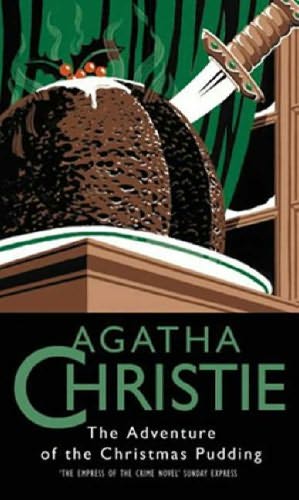
Adventure of the Christmas Pudding (1960)

Plot: A collection of "two main courses and a selection of entrees".


Short stories - some reprints from much earlier, one a rewrite, one an old story with a new title. Only the first story is "Christmassy" - Poirot is invited down to spend Christmas and unmask a jewel thief in a country house. In many ways this story is a pastische of what people think an Agatha Christie mystery to be - country house, bright young things, complications, impostors, glamorous thieves, lots of snow and servants, a dead body, a taint of international intrigue and a twist or two.

It's notable for showing Poirot staging a crime which is also a rather macabre practical joke. The other thing this isn't really is a "whodunnit" since it turns out that the thief is, er, well, pretty much who it was supposed to be all along.

It is the first story in the collection to feature disguise and assumed identity - an idea which is played out again in The Under Dog, and then rather more dramatically in The Dream, Four-And-Twenty Blackbirds, and Greenshaw's Folly. In fact, the shame of these last three stories is that the trick in each case is identical. Admittedly they're very different stories, but you wonder if Poirot spent his entire life surrounded by people in false whiskers.

The Dream is a very interesting story in that it places Poirot up against the supernatural. This is a terrible idea on the crook's part, as Poirot cannot accept an impossible explanation, and therefore solves the crime. It's also a match between the villain and Poirot's vanity - and there's no doubt who can win this one.

Servants underpin both The Under Dog and The Adventure of the Christmas Pudding. In the latter, Poirot receives a warning from a worried maid, in the first Poirot finds himself trying to rationally solve a murder while Lady Astwell jumps up and down pointing at a hapless secretary and denouncing him based only on feminine intuition.

The Under Dog and The Dream are both classic "House of Evil" adventures in miniature - a dead and unpleasant businessman, impostors, put-upon secretaries, a not-exactly grieving family.

These tropes rear their head again in Greenshaw's Folly, a Miss Marple story that features a strange house, its eccentric owner, resentful housekeeper, wretched gardener, locked door mysteries, a policeman, lost relatives, and a fair amount of disguise. It also, remarkably, features a divorced woman who is employed as a secretary. There's also a very strange sense of the story heading in one direction and then turning in another (there's a lot of mention early on about clocks and hidden treasure), but this may just be misdirection from the mystery here being remarkably similar to two other stories in the collection. In many ways the story fits in much better in "Miss Marple's Final Cases", an anthology which allows Miss M to shine, and where the mysteries are sufficiently different to prevent the reader from groaning "not again". Especially as you have Miss Marple solving the mystery by magic and also dropping the wonderful line "When I was a girl, Inspector, nobody mentioned the word Stomach."

Finally there's The Adventure of the Spanish (Baghdad) Chest. Which is a weird and satisfying blend of Othello and Rope, mixed in with a truly gruesome method of murder that's curiously like something out of Edgar Allen Poe. It's curiously like a stage play, and isn't really so much a mystery as a poisonous puzzle box.

Next: More short stories with Poirot's Early Cases

Monday, 28 December 2009

Hercule Poirot's Christmas (1938)

Plot: A yuletide death in the family fails to bring comfort and joy.


Merry Christmas! Towards the end of her career, Agatha Christie books were published as "A Christie for Christmas". In the 1960s, when her output slowed, her publishers tactfully let it be known that they'd let her off the hook and publish a "Ngaio Marsh for Christmas". The result was By The Pricking Of My Thumbs by return of post.

Even today, Christie adaptations glut the festive schedules - it seems we all love a good murder and a mince pie, and the nostalgic world that Christie evokes seems as much a part of the myth of Christmas as roaring fires, carol singing, snow and mince pies.

Viewed nostalgically, it seems surprising that more Christies aren't set at Christmas. There is, I think, this book, a Poirot short story and the first Harley Quinn mystery sees in the New Year. And that's about it.

Oddly, Hercule Poirot's Christmas is not a very Christmassy book. The Sittaford Mystery is at least snowier - indeed, the lack of Christmas decorations forms a late plot point, when Pilar Estravadors discovers them in a cupboard and comments on her expectations of "the crackers and the burning raisins and those shiny things on a tree..."

Christmas is simply an excuse for wicked old Simeeon Lee to gather his family around him - yes, it's the good old country House of Evil again, with the miserable live-in relatives, the exotic strangers from abroad, the returning prodigals, and curious servants, mixed in with impostors and spongers. This is pretty much the set-up of A Pocket Full of Rye, bolted onto the structure of a typical Poirot (death-interrogation-revelation).

If it all feels a little staged, this turns out to be part of Christie's plan. She even allows a character to comment "this is one of those damned cases you get in detective stories where a man is killed in a locked room". The reader will even spot the point, two-thirds in, where Poirot solves the murder and simply treads water until it's time to reveal the solution.

That this is a "locked room" murder is actually quite extraordinary in Christie's work. She adores the impossible mystery, but normally avoids the obvious impossibility of the locked room, leaving those to Carter Dickson. That she's chosen to employ this device is very deliberate here - she is throwing the reader's mind to thinking "how did the villain commit this crime and escape" rather than "why was the room locked in the first place?"

The whole thing is an elaborate sleight, which becomes quite easy to resolve once you realise who the murderer is. This is theoretically quite easy in this book - Simeon Lee drops several unconscious hints before his demise which Christie frequently reinforces - but in practice you may well miss it because it's just not where you're looking.

Again this is down to Christie. By the end you realise that this book is deliberately formulaic - the old house, the sequential interrogations, and other trusty bits of Christie's false machinery all wheeled out to keep you baffled.

This is helped by the book's mostly pallid characterisation. It's quite easy to forget who is who among the Lee clan (oh! so many brothers and wives). Christie even jogs your elbow by introducing Pilar Estravados, Lee granddaughter, who is the most striking woman in the book. So wonderfully radiant is Pilar that it makes the other Lee women very dull indeed, and even casts most of the men into shadow. Pilar is magnificently unBritish and unsentimental - she likes Simeon Lee, despite his immorality, she is unabashed about her selfishness, and isn't ashamed to be an adventuress, which throws her up against the book's two returning colonials, who are again rather less interesting.

Pilar, indeed, draws so much attention that the book becomes a did she/didn't she. If she did, then it's disappointing, but if she didn't, then who could possibly be as satisfying a villain? So bright is her star that it's impossible to forget that, as everyone admits, she had nothing to gain by killing Simeon Lee. Or did she, after all?

At the end of it all, Hercule Poirot's Christmas is a great example of what appears to be a by-the-numbers work by a master of the genre, but is, in fact, rather more than that.

Next: Yuletide merrymaking continues with The Adventure Of The Christmas Pudding

Sunday, 20 December 2009

And Then There Were None (1939)

Plot: Ten strangers trapped on an island start to die. Are any of them innocent?


I've never liked the "N-word". It's one of those words that manages to sound offensive and derogatory, in the same way as "Faggot" or any of those short and magnificently abusive Anglo-Saxon terms that just slip out whenever I try and use the Northern Line. It's a horrible, nasty word, and one that is, these days, thankfully repugnant. Like parquet flooring, it is being usefully reclaimed, but it remains pretty much unusable and unsayable unless in very careful contexts.

It is scattered through the first version of Agatha Christie's most infamously titled book like bones in a kipper. The expurgated text is a far easier read nowadays, and one in the eye for the "political correctness gone mad" brigade. I've just finished reading the original version, and it's a mildly queasy journey. The sheer outdated proliferation of the word is simply a distraction from a brilliantly good book. If the book wasn't so good, I don't think so much of a fuss would have been made about the troublesome title.

One thing that surprised me was discovering that the book was known as "Ten Little N-s" in England up until 1979. Really? Even more alarming was looking at the cover of my 1979 Fontana edition:


This neatly knocks on the head the BNP's odious argument that the Golliwog has no racial connotation and is simply a figure of fun like a teddy bear. Yeah right. It also, if you look at the lizard's face, contains a pretty massive clue to the murderer. So, it's doubly offensive.

But how sensitive should we be about this? In Christie's defence, she's certainly not the only author of the period to use the term, and she uses it with all the thoughtless abandon of someone with no offensive intent. This is not a book aimed at inciting racial hatred - the use of the N-word is such an incidental detail that it's almost Christie's biggest ever red-herring - and the success with which the text has been stripped of it proves how inconsequential it was to the narrative in the first place. Indeed, American pretty much immediately insisted on calling the book "And Then There Were None" - this book isn't known over there under the original title, which made for quiet a surprising recent protet in the US when a local NAACP president tried to block a High School production of the play And Then There Were None - on the grounds that it was based on a book which had once had a different title In Another Country. Which seemed a bit surprising - but then one has to, just as with Christie, be aware of the context. A lot of the reporting of this case appears to be from what you might call the political right. As I said - context it everything.

For instance, And Then There Were None does contain one really racially repugnant character - a horrible Jewish man, who is mocked and villified. Which is particularly unpleasant since this is 1939. You can mount a defence that we only really see Mr Isaac Morris from one character's viewpoint, and he's not necessarily sympathetic... but still, it's unfortunately tactless to say the least. Which is about the worst you can see about this book.

With that lengthy preamble to one side... what about the book? Well, it's utterly brilliant. It's a great concept - 10 strangers all at the mercy of a mysterious nemesis. It's easy to forget that it's not until late on that you realise the murderer is amongst them... or are they?

This is a game of psychological torture played out with the usual Christie suspects (Dashing Young Man, Military Man, Old Maid, Colonial Adventurer, Noble Mouse, Humble Retainer etc...) the exception being that They're All Guilty.

Freed from having to have a proper investigation, or even really a detective, Christie runs wildly experimental. We really see inside everyone's minds - these are complicated people, for once deceiving themselves rather than Hercule Poirot. There are even a few remarkable scenes where Christie treats us to everyone's inner thoughts - including the murderer's. It's really thunderingly good at what it does - it's about suspense and justice and victims and innocence.


It's curious - these people are all scoundrels, but you do find yourself rooting for some of them. Christie is so good at drawing these types of people that it's hard to hate all of them. She even take great delight at building up the first victim as a shining god among men, a truly handsome brute - and then swiftly polishing him off.

The rhyme works here more even successfully than in A Pocket Full Of Rye - it's more than just a narrative frame, it's almost a narrator, taunting and warning the cast as events press remorselessly on to their grim conclusion.

Interestingly the play version has a different ending - and, as this is the basis of the film, it is quite remarkable when reading the book to realise that events are taking a very different turn indeed.

Next: Festive fury in Hercule Poirot's Christmas

Tuesday, 15 December 2009

A Pocket Full of Rye (1954)

Plot: Murder by nursery rhyme brings Marple to Yewtree Lodge.


This story mixes Death By Nursery Rhyme with the House of Evil magnificently. It helps that this is a really very well written book - it's full of carefully observed human behavious, and again features a typing pool (just as entertaining as in The Clocks and They Came To Baghdad). The typing pool gives us our opening:

"It was Miss Somers's turn to make the tea. Miss Somers was the neewest and the most inefficient of the typists. She was no longer young..."

Much is made of Christie's poisonous work at a dispensary, but clearly she also understood office warfare. The scene where the staff argue over who to call when they find their boss has been poisoned is brilliantly funny and also features a clash between Old Medicine and the NHS ("They won't come. Because of the National Health.") and even discussion of 999.

To prove that Christie has moved with the times, there's much discussion of The Servant Problem. Instead of the wonderfully staffed houses of the 1920s, Yewtree Lodge is understaffed, but order is kept by the marvellously dry Miss Dove not afraid to help out with cooking, cleaning and dishing up (an echo of the splendid Lucy Eylesbarrow in 4.50 from Paddington).

Yewtree Lodge is a return to the House of Evil that we first saw in The Mysterious Affair At Styles. The whole household are variously described as unpleasant, nasty and odious. These are all unhappy people bound together by secrets and mealtimes - an unhealthy atmosphere that results in murder. The catharsis of murder is like the cleansing of the stables - by the end of the book most of the cast may be dead, but those who remain have found a measure of happiness and contentment.

A lot of this is brought about by Miss Marple who is deliberately ordinary. The Police Inspector just accepts her: "Miss Marple was very unlike the popular idea of an avenging fury. And yet, he thought, that was perhaps exactly what she was."

She is both winged nemesis and a cup of hot cocoa. There's a lovely scene where we find Miss Marple has temporarily transformed Yewtree Lodge simply by sitting in a corner of it and knitting. As one character remarks:

"With the fire and the lamps and you knitting things for babies. It all seems cosy and homely and like England ought to be."

To which Miss Marple replies: "It's like England is."

If Miss Marple restores order, she also pigeon-holes people. Young Pat, married into the poisonous family, is, Miss Marple decides, out of place: "A background of shabby chintz and horses and dogs, Miss Marple felt vaguely, would have been much more suitable that this richly furnished interior decor."

Amidst all the bodies dropping like flies, it is easy to forget that Miss Marple comes not to avenge the death of the financier, or his fine wife, but their plain silly servant girl - simply because Miss Marple knew her and liked her, despite her foolishness. Again, it's a sign of the changing times that we get mention of holiday camps and motion pictures filling girls' heads with ideas above their station.

Again and again this is a novel about people being neatly dusted down and put in their proper place like ornaments. Poor Gladys would not have died if she hadn't had fancies beyond a teashop. Pat would be happier with horses. And Miss Marple decides that Mrs Percvial Fortescue is like Mrs Emmett the bank manager's wife in St Mary Mead. He had "married beneath him and the result was that his wife was in a position of great loneliness since she could not, of course, associate with the wives of trades people."

In this book we see clearly that Miss Marple does not strive for utopia, simply for the status quo. When asked if St Mary Mead is a nice place, she's not romantic:

"It's quite a pretty village. There are some nice people living in it and some extremely unpleasant people as well."

Structurally, the book makes another great change from formula Poirots of 100 pages of set up, a murder, some interrogations and some unmasking. The corpses start piling up pretty much from the first page, and you can tell that Christie is having enormous fun working out her plan.

This brings us to the nursery rhyme, which either both fits the story superbly and clangs around like ball bearings in a bean bag. It adds to the almost supernatural feeling of murder as a negative force of vengeance, the exact opposite of Miss Marple. The twists and turns of the plot that explain the rhyme are clever and cunning... but, at the same time, you realise the significance of the rhyme is the very weakness of it as a device. It's almost like the killer is revealing their plot. As Miss Marple points out at a certain point in the book, there will be no more killings because there is no rhyme left. Worse, she's worked out that there simply must be a connection between the blackbirds in the rhyme and the mysterious Blackbird Mine... a connection which makes it painfully easy to work out who the murderer is simply by spotting who keeps on mentioning the mine...

And yet this remains a great, great book and another triumph for Miss Marple. If not, we realise at the end, a triumph for the Royal Mail; Miss Marple gets home, order restored, chaos thwarted, and finds a misdirected letter which would have solved the case if it had been delivered on time.

NEXT: And Then There Were None: A triumph of plot over racism?